
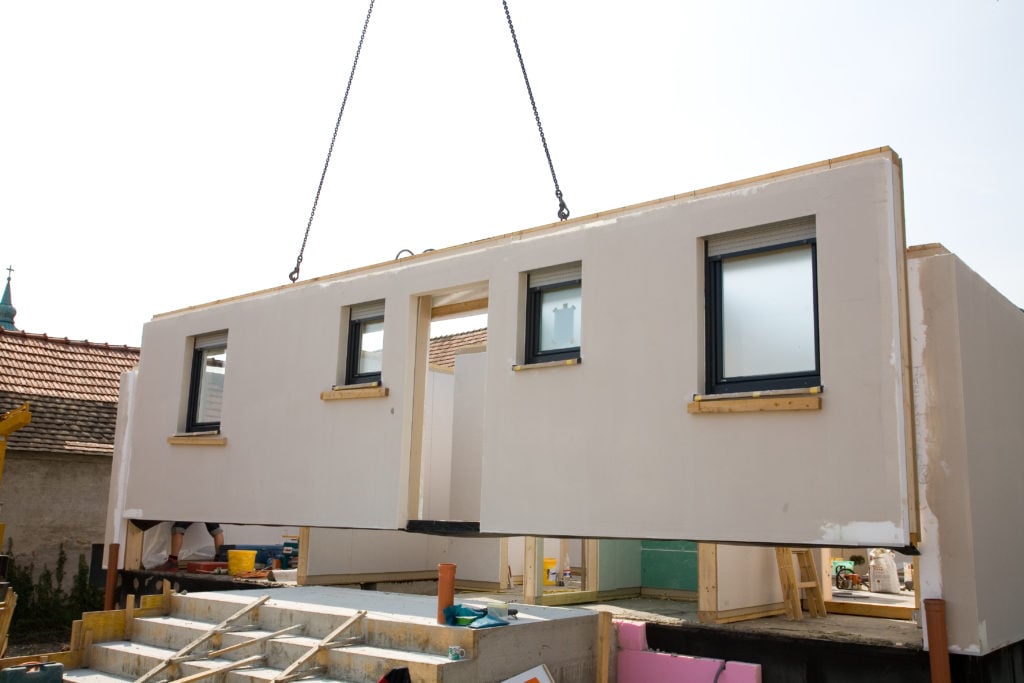
What is a prefabricated building?
A prefabricated building (also known as a “prefab” or “modular building”) is a building that is constructed off-site at a climate-controlled facility. They are manufactured using factory-made units or “modules”. Then, the parts are delivered to the building site and assembled, using cranes and other construction machinery. Prefabrication allows companies to spend time building parts in advance – such as walls, light fixtures, and more. Then, they can quickly and easily construct them on-site. Unlike traditional construction, the assembly of prefabricated buildings requires minimal skilled labor, foundation requirements, and special equipment. Learn more about Modular Construction here.
Why are they gaining popularity?
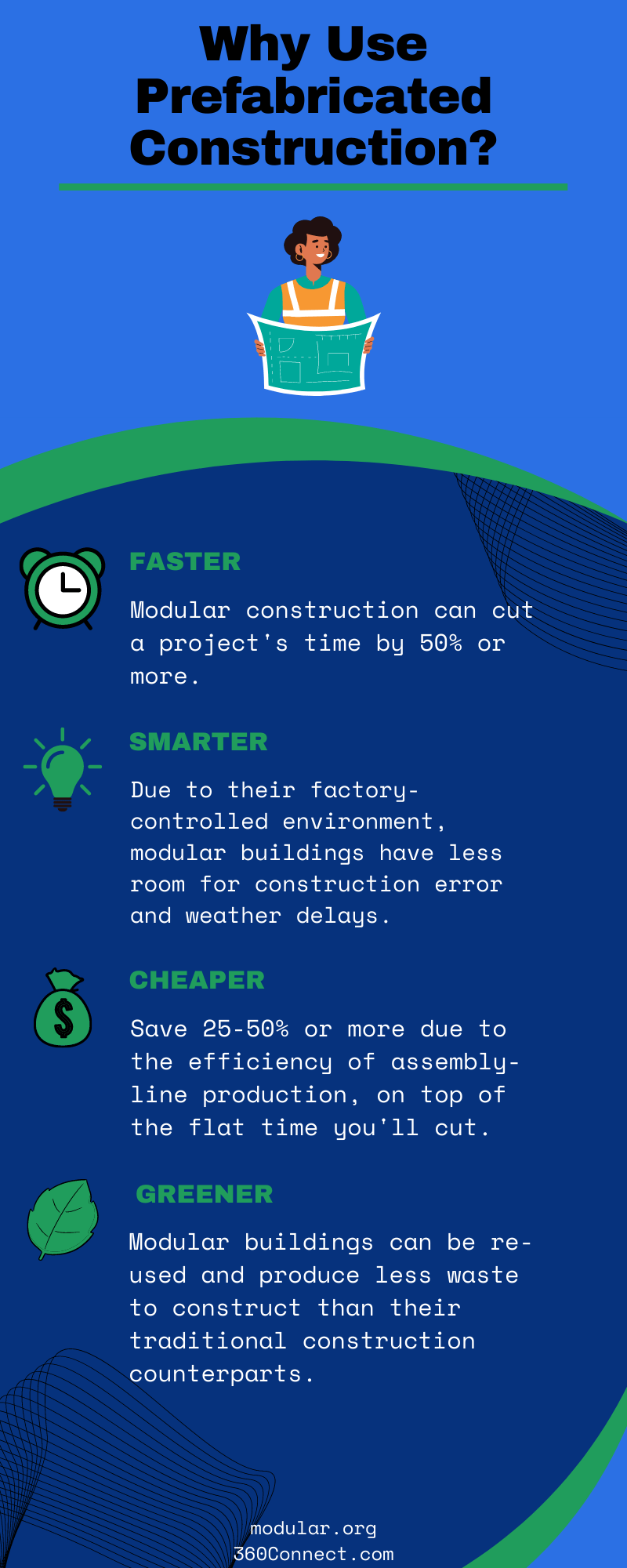
Prefabricated buildings are becoming very popular options – for both construction companies and building buyers. There are many reasons why companies and buyers are starting to prefer prefabrication. The top reasons include:
Quick construction time
For building buyers, there are tons of advantages to choosing a prefabricated building over a traditionally-constructed building. First of all, prefabrication is a turn-key solution to space needs. Since companies can manufacture building parts off-site prior to building, the actual project time gets cut in half or more. These days, many businesses and homeowners need their buildings to be erected very quickly. Some simply don’t have the time to wait a year or more for traditional construction to be finished.
Verified, consistent quality
Prefabrication is an organized process that leaves little room for error. Companies follow strict regulations that assure high quality, code-compliant products. The result is well-constructed units that are high-grade, follow building codes, and look attractive once assembled on-site.
Cost Savings
One of the biggest perks to prefabricated buildings is their cost efficiency. First of all, with less needed labor and time to build, you’re paying less in labor costs. Plus, since the parts are made in a factory, it allows construction companies to control costs. When you think about it, it’s a no-brainer! Prefabricated building customers save an average of 25-50% compared to traditional construction. This opportunity is so enticing that corporations like Marriott vowed to use prefabricated construction for 13% of its hotel deals in 2017 “to bring down building costs.”
Labor efficiency
For construction companies, there are many reasons to turn to prefabrication. Tom Hardiman of Modular Building Institute told Forbes that during the last recession, the construction industry lost many skilled laborers. The industry needed greater efficiency, which made prefabricated buildings a great opportunity. There is still a shortage of skilled labor in the construction industry. Prefabrication eases this issue by offering more controlled, flexible labor that is also time conducive.
Key Components of a Prefabricated Building
A prefabricated building is made up of several factory-built components that are manufactured off site and then assembled on site. These include:
- Prefabricated panels (walls, exterior walls, and partitions)
- Structural elements like steel framing and load bearing components
- Floor systems including floor trusses and mezzanine floors
- Roof systems and insulation such as structural insulated panels
- Mechanical and electrical systems pre-installed in modules
These prefabricated building components are created in a controlled environment, ensuring precision engineering, better structural integrity, and faster installation at the construction location.
Types of Prefabricated Buildings
There are several types of prefab buildings, each designed for different construction projects:
1. Modular Prefabricated Buildings
Fully constructed modules manufactured off site and assembled on site. Ideal for offices, healthcare facilities, and commercial buildings.
2. Panelized Construction
Flat panels (walls, floors, roofs) are built in a factory and assembled at the building site.
3. Precast Concrete Buildings
Use precast concrete panels for structural strength, often used in industrial buildings and warehouses.
4. Portable and Temporary Prefab Structures
Used for modular offices, construction site offices, and temporary facilities with rapid deployment needs.
Who uses prefabricated buildings?
The short construction time, high quality, and cost savings make prefabricated buildings desirable for many industries. Plus, the quality of prefabricated buildings is becoming better year over year. Prefabrication is more about how the building was made rather than the kind of building it is. Therefore basically any professional company can make use of a prefabricated building.
With that being said, some industries may need a turn-key construction method due to a variety of limitations. For instance, they may be on a tight budget. Additionally, they may need the space to be up and running very quickly or need uniformity in structure that prefabrication provides. For those reasons, the top industries that have been turning to prefabricated buildings are:
- Corporate and professional offices
- Healthcare facilities
- Pharmacies
- Commercial retail
- Hotels
- Real Estate
- Institutional buildings, such as prisons and police stations
- Educational facilities
The number of large, well-known companies choosing modular buildings speaks for the value! Marriott, Google, McDonald’s, and even Yale University are among the large companies that have been choosing these kind of buildings.
Related: Top Commercial Modular Building Companies
How are prefabricated buildings designed?
There are many different choices when it comes to designing prefabricated buildings. They can be built using:
- Panelized framing
- Steel framing
- Wood framing
- Concrete systems
- Modular systems
- And more
Additionally, one of their perks is that they are can be customized in a number of ways – in terms of appearance and functionality. Since the parts are prepared off-site, you can talk with your supplier about your building’s design. Have any climate, geographical, or other location-based needs? Suppliers can easily construct the parts to withstand those conditions.
Nowadays, prefabricated buildings are associated with a “modern” look that is becoming popular. Plus, prefabricated buildings are associated with the “green movement,” since they’re made with environmentally friendly, sustainable materials.
When Should You Choose a Prefabricated Building?
A prefabricated building is the right choice when:
- You need a building completed in half the time
- Your project requires cost efficiency and budget control
- You want minimal disruption at the construction site
- You need scalable or relocatable modular structures
- Your project demands consistent quality control
For many businesses, prefab construction offers a smarter alternative to traditional construction projects, especially when speed and cost savings are critical.
Prefabricated Building vs Traditional Construction: Key Differences
When evaluating a prefabricated building versus traditional construction methods, it’s important to understand how the construction process, cost, and timelines differ. Both approaches serve different needs, but prefab construction is increasingly preferred for speed, cost efficiency, and quality control.
| Feature | Prefabricated Building | Traditional Construction |
| Construction Process | Manufactured off-site in controlled factory environments and assembled on site | Built entirely on the construction site |
| Project Timelines | Faster delivery, often completed in about half the time | Longer timelines due to weather delays and on-site dependencies |
| Cost Efficiency | Significant cost savings due to reduced labor and material waste | Higher costs due to labor, delays, and excess materials |
| Quality Control | Higher quality control with precision engineering and factory standards | Varies depending on site conditions and workforce |
| Material Waste | Less waste due to exact specifications and controlled production | More material waste due to on-site cutting and errors |
| Labor Requirements | Reduced on-site labor and improved labor efficiency | Requires more skilled labor on-site |
| Environmental Impact | Lower carbon footprint and minimal disruption | Higher environmental impact and site disruption |
| Flexibility | Modular components allow easy expansion and relocation | Less flexible once constructed |
Ready to see if a prefabricated building is the right choice for you? We connect you with up to 5 trusted suppliers in your area. They get in touch and give you free quotes on the building you need. To get started, check out our modular building quote page to get in touch!
Frequently Asked Questions About Prefabricated Buildings
How is prefab construction different from traditional construction?
Prefab construction involves manufacturing building components in a controlled factory environment, while traditional construction happens entirely on site, often leading to longer timelines and higher costs.
Are prefabricated buildings durable?
Yes, prefabricated modular buildings are designed with strong structural elements like steel framing and precast concrete, ensuring high structural integrity and long-term durability.
What are the benefits of prefabricated buildings?
Key benefits include faster construction process, reduced material waste, lower labor costs, better quality control, and significant cost savings compared to traditional methods.
What types of prefabricated buildings are available?
Common types include modular buildings, panelized construction, precast concrete structures, and portable prefab buildings used for offices, healthcare, and industrial facilities.
Are prefabricated buildings cost-effective?
Yes, prefab buildings are highly cost-effective due to reduced labor, shorter project timelines, and minimized excess materials, often saving 25–50% compared to traditional construction.
Where are prefabricated buildings commonly used?
They are widely used in commercial buildings, healthcare facilities, educational facilities, industrial warehouses, and modular office spaces.
Ready to see if a prefabricated building is the right choice for you? We connect you with up to 5 trusted suppliers in your area. They get in touch and give you free quotes on the building you need. To get started, check out our complete buyer’s guide or visit our modular building quote page to get in touch!